Zero Trust for a 10-Person Team: Overkill or Overdue?
Ten employees. One shared Google Drive, a Slack workspace, maybe a CRM, and a laptop for everyone. That’s the whole company. So when a vendor pitches “zero trust network access,” the reaction is usually the same: that sounds like something a bank needs, not us.
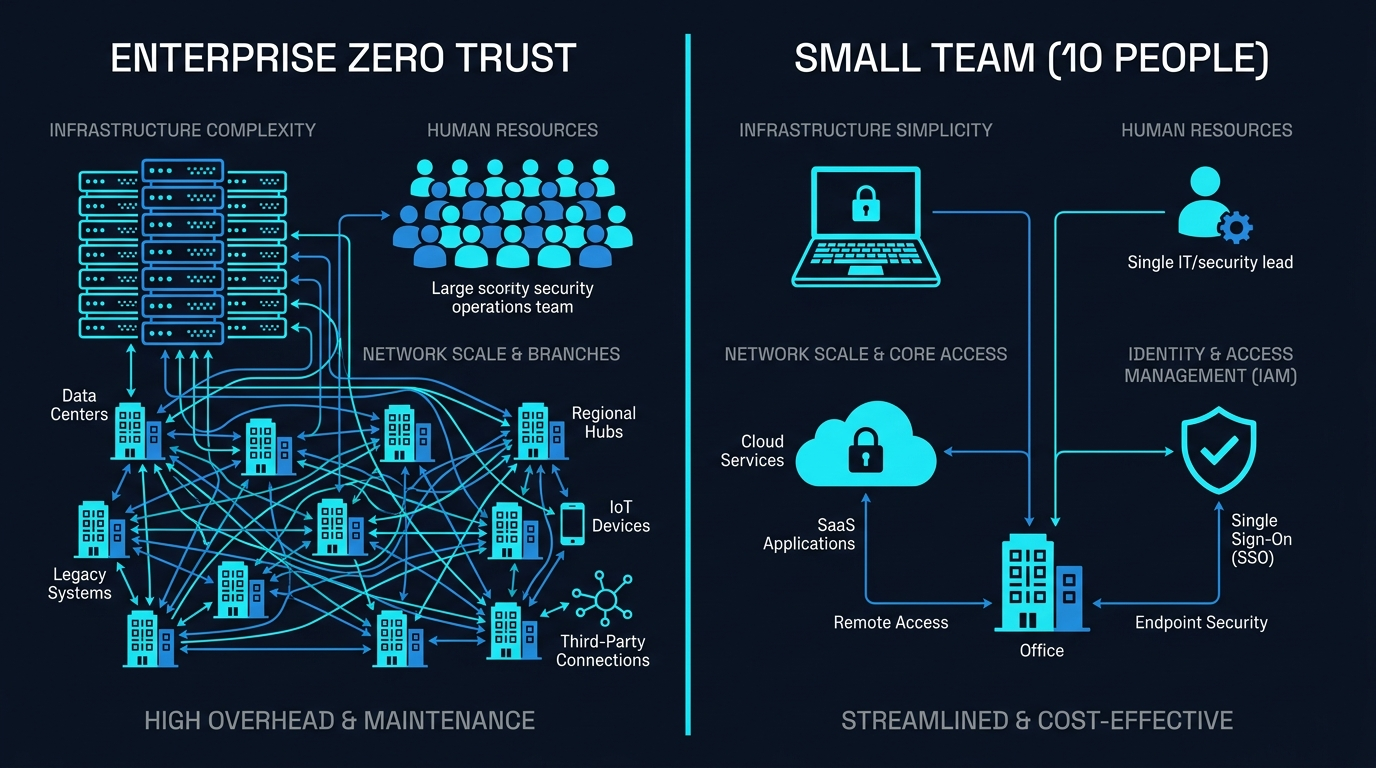
It’s a fair reaction. Zero trust got its reputation from Google’s BeyondCorp project and enterprise rollouts involving thousands of employees, dozens of offices, and security teams larger than most small businesses altogether. Picturing that scale at a ten-person company does sound absurd.
But the mental picture is wrong. The data on who actually gets breached tells a different story than most small business owners assume.
Small Companies Are Not Too Small to Be Targets
There’s a persistent belief that cybercriminals only bother with large companies because that’s where the money is. The breach data doesn’t support it.
The Proton Data Breach Observatory tracked breaches across company sizes in 2025 and found that businesses with fewer than ten employees accounted for 23% of the incidents in its dataset, not a rounding error against enterprise breaches, but a meaningful slice on their own. Automated attack tools don’t check headcount before scanning. They look for exposed logins, unpatched software, and weak remote access setups, and a ten-person company running a flat network with shared passwords looks just as promising to that tooling as a five-hundred-person company would.
The harder question is what happens once an attacker gets past the front door. Total Assure’s 2026 SMB Cybersecurity Report found that attacks against businesses this small succeed 47% of the time, a rate well above what most owners assume, largely because there’s usually less standing between a stolen password and full access to everything the company owns. Larger companies segment their networks and require multi-step verification as a matter of course. Small teams often skip both.
The cost of that success isn’t trivial either. The same Total Assure report puts average losses at $254,000 once recovery, downtime, and client fallout are added up. For a ten-person company, a loss that size can end the business outright, and the owners seem to know it: a 2025 VikingCloud SMB Resilience Study found that 40% of small business owners say a breach costing $100,000 would be enough to shut them down.
Why “We’re Too Small to Bother With Security” Gets the Threat Backwards
Part of the confusion comes from picturing zero trust as a defense against sophisticated, targeted hacking. That’s not what’s driving most of the risk for small teams.
CrowdStrike’s 2024 Global Threat Report found that 79% of the attacks it tracked involved no malware at all. Attackers used stolen or legitimate credentials to walk straight in, whether that meant a password reused from a breached shopping site or a session token grabbed off an unsecured coffee shop network. Traditional perimeter security, the kind built around an office firewall and a VPN, has almost nothing to say about that scenario. A valid password walks right past it.
There’s also a growing size-specific pattern. Accenture’s analysis of attack trends over an 18-month stretch found that attacks targeting companies with 10 to 49 employees rose 152%, a sharper increase than the broader cybercrime baseline. That lines up with a fairly simple explanation: attackers have noticed that small businesses often skip the access controls larger companies have adopted, which makes them an easier target even when the eventual payout is smaller.
What “Right-Sized” Zero Trust Actually Looks Like
None of this means a ten-person company needs what Google built. Full enterprise zero trust architecture, with dedicated security staff, custom policy engines, and integration across dozens of internal systems, would be overkill for a team this size. That’s a different thing from zero trust itself.
The practical version looks much smaller. It starts with verifying who’s logging in and from what device before granting access to specific tools, rather than trusting anyone who’s already inside the network. For a ten-person company, that usually means identity-based access to cloud apps, not a rebuilt network.
Cost estimates from ZeroTrustCost.com put a small-team rollout in the range of roughly $0 to $15 per user per month, depending on which tools are already in place and how much is added. The same source notes that cyber insurers have started factoring these controls into pricing, with some carriers cutting premiums by 10% to 25% for businesses that can show identity-based access controls are in place. For a company already paying for cyber insurance, that’s a partial offset against the cost of getting set up.
Tools like NordLayer are built around this smaller-scale use case, letting a team set up identity-based access without a network overhaul or a dedicated security hire. If you sign up through some of the links in this article, EdgeTrustNetwork may earn a commission at no extra cost to you.
Where to Start
A phased approach beats trying to lock everything down at once. A reasonable order looks like:
- Turn on multi-factor authentication everywhere it’s available, starting with email and file storage.
- Move remote access to the CRM and financial tools behind identity verification instead of a shared VPN password.
- Segment access so a compromised laptop doesn’t automatically mean access to payroll or client records.
- Add device checks so logins from unmanaged or unfamiliar devices get flagged before they’re trusted.
None of these steps require the security headcount of an enterprise. They require picking tools built for teams this size and working through them one at a time.
The Bottom Line
Zero trust as Google built it would be overkill for a ten-person company. Zero trust as a set of identity-based controls, phased in over a few months, is closer to catching up than overreaching. The breach data from Proton and Total Assure, the credential-based attack patterns CrowdStrike documented, and the size-specific rise Accenture measured all point the same direction: small teams aren’t too small to be worth attacking, they’re often just easier to get into.
Ten employees, one shared drive, one Slack workspace, and now one door to watch instead of a dozen unguarded ones. That’s still the whole company. It’s just a harder one to walk into uninvited.