ZTNA Rollout Timelines: What Actually Happens Between Month 1 and Month 18
A vendor tells you Zero Trust Network Access can be “live in weeks.” Your IT lead, who has actually migrated a VPN before, gives you a look that says otherwise. Somewhere between those two claims is what really happens when a small business decides to stop trusting its network by default and start verifying everything instead.
The honest answer isn’t a single number. It’s a range, and the range matters more than any headline figure a sales deck puts in front of you.
The Honest Answer
According to GrackerAI’s May 2026 research on Zero Trust Network Access adoption, most organizations should plan for somewhere between 6 and 18 months to move from initial planning to a mature rollout, with the actual figure depending heavily on company size and how much legacy infrastructure needs to be untangled along the way. A ten-person consultancy with cloud-only apps sits at the short end of that range. A 150-person manufacturer running a mix of on-premises servers, older point-of-sale systems, and a patchwork of remote access tools built up over a decade sits much closer to the long end.
That range isn’t a hedge. It’s the point. Any vendor promising a fixed number of weeks for “full Zero Trust” without asking about your environment first is selling a demo, not a deployment.
Why That Range Is So Wide
Three things stretch or shrink a ZTNA timeline more than anything else: how complex your application environment already is, how much legacy technology you’re carrying, and whether you have staff who can own the project without it becoming a side task nobody has time for.
Complexity compounds. An organization with one office, standardized laptops, and apps that already live in a handful of cloud platforms has a fairly contained scope to work through. Add multiple locations, a mix of managed and unmanaged devices, contractors who need partial access, and an ERP system that was never designed with modern authentication in mind, and the same rollout multiplies in scope even though the company itself might not be much bigger.
Legacy systems are usually the real time sink. Modern cloud applications tend to support the identity and access protocols ZTNA depends on without much friction. A file server running on a ten-year-old operating system, or a proprietary application with hardcoded network assumptions, often needs custom work-arounds, compensating controls, or a parallel migration project of its own before it can sit comfortably behind a Zero Trust model.
Staffing is the quieter variable. A dedicated project owner who can make decisions, chase down departments, and keep the rollout moving tends to compress the timeline. A rollout that gets assigned to someone’s already-full plate, revisited only when there’s a spare afternoon, tends to drift toward the long end of the range almost by default.
The Actual Phases
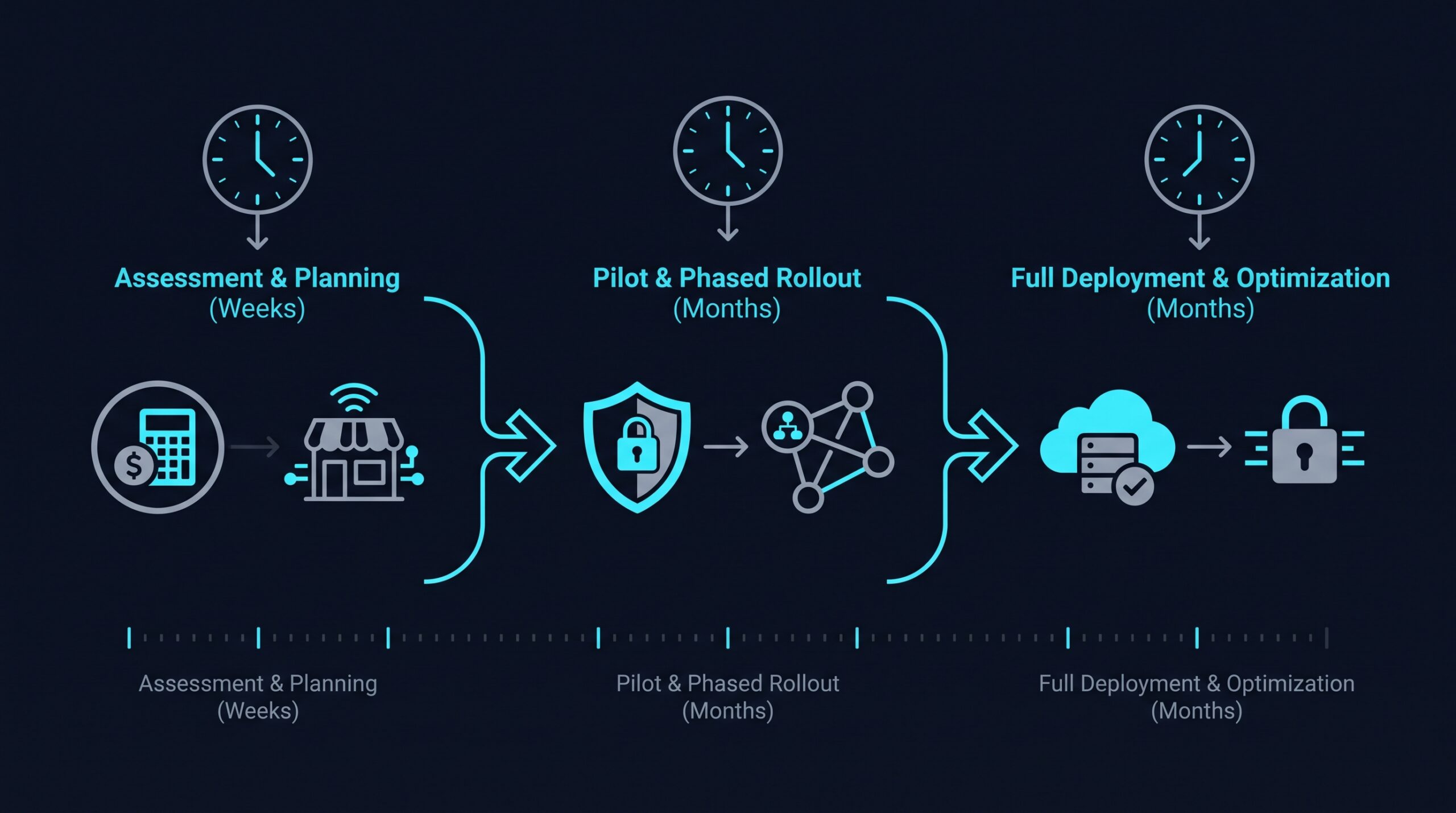
Rollouts don’t move evenly across an organization. According to GrackerAI’s May 2026 findings, the time typically breaks down into three broad phases, and understanding them helps explain why the middle of a project can feel slower than the beginning.
Phase One: Identity Comes First
Before any application gets locked behind Zero Trust policies, the organization needs a clean picture of who its users are, what devices they’re on, and how identity gets verified. This usually means consolidating identity providers, cleaning up stale accounts, and setting up multi-factor authentication as a baseline. It’s unglamorous work, but it’s the foundation everything else sits on, and skipping ahead of it tends to create rework later.
Phase Two: Applications Get Moved One at a Time
Once identity is solid, applications get brought under the Zero Trust model in waves rather than all at once. Lower-risk, cloud-native apps usually go first because they’re the easiest to verify and roll back if something breaks. Higher-risk or legacy systems come later, once the team has practice and confidence from the earlier waves.
Phase Three: Policies Get Tuned, Not Just Deployed
The last stretch of time goes into refining access policies so they’re tight enough to matter but not so rigid that employees are constantly locked out of things they legitimately need. This phase is where a lot of the “extra months” in an 18-month timeline actually live, because policy tuning depends on real usage patterns that only show up after people have been working inside the new system for a while.
Quick Wins Are Real
None of this means a business has to wait a year and a half to see any benefit. According to GrackerAI’s May 2026 analysis, organizations can typically demonstrate concrete value within about three months, even while the broader rollout continues in the background.
A common early win is securing remote access for a specific group, like finance or leadership, who handle sensitive data and benefit most from tighter controls immediately. Another is replacing a legacy VPN for a subset of users as a proof of concept before extending it company-wide. These early milestones matter for reasons beyond security. They give the project visible momentum, which makes it easier to justify continued budget and attention through the slower middle phases.
Some platforms are built with this staged approach in mind. NordLayer, for instance, positions itself as something businesses can start applying to a subset of users or applications before expanding further, which fits how most realistic rollouts actually unfold rather than assuming an all-or-nothing switch. (If you sign up through some of the links in this article, EdgeTrustNetwork may earn a commission at no extra cost to you.)
The “Done” Trap
Here’s where a lot of teams stumble, not on execution, but on expectations. When the rollout phase wraps up, and every planned application is finally sitting behind Zero Trust policies, it feels like the project is finished. It isn’t. It has just changed shape.
Rollout completion and operational maturity are different things. A finished rollout means the architecture is in place. Maturity means the policies have been lived with long enough to catch the edge cases, the access reviews happen on a schedule instead of when someone remembers, and new employees or new apps get onboarded into the system without someone having to relearn the process from scratch each time. Treating the end of rollout as the finish line is how organizations end up with a Zero Trust deployment that technically exists but quietly decays.
The Derailment Patterns
According to GrackerAI’s May 2026 research, a recognizable set of patterns tends to show up when ZTNA projects stall out in their second year, and most of them trace back to the same root cause: the project lost its champion or its attention, not its technical footing.
One common pattern is scope creep without a matching timeline adjustment. The plan was to cover ten applications, but by month eight it’s covering eighteen because “we’re already in there,” and nobody revisited the schedule or the budget to reflect that.
Another is the departure of the person who owned the project. Zero Trust rollouts tend to depend on one or two people who understand both the technical details and the organizational politics of getting departments to change how they work. When that person leaves or gets reassigned, momentum tends to drop sharply until someone else picks it back up, if anyone does.
A third pattern is treating the rollout as a one-time IT initiative rather than an ongoing operational shift. Once the initial excitement fades, policy reviews stop happening, new hires get access the old way “just for now,” and the system slowly reverts toward the loose access model it was meant to replace.
For Small Businesses Specifically
There’s a real advantage small businesses have that often gets overlooked in vendor pitches aimed at enterprises: fewer moving parts. If your identity setup is already reasonably clean, most employees are on company-managed devices, and your applications are mostly cloud-based already, you’re starting a meaningful distance ahead of a company with ten offices and three decades of accumulated infrastructure.
This doesn’t shrink the range down to nothing. But a fifteen-person business with modern tooling might realistically be looking at the low end of the 6-to-18-month window, while a larger organization with more legacy weight sits further out. Small size doesn’t guarantee speed on its own, but it removes several of the friction points that slow larger rollouts down.
Set Expectations Early
The teams that tend to move fastest are, somewhat counterintuitively, the ones that push back hardest against unrealistic timelines at the start. A team that agrees to “full Zero Trust by end of quarter” because it sounds good in a meeting is setting itself up for a rushed rollout, skipped identity groundwork, and policies that get loosened under pressure just to hit a date. A team that says “identity and our highest-risk applications by end of quarter, full coverage in a year” is giving itself room to do the phases in the right order.
Setting an honest timeline isn’t a sign of weak ambition. It’s usually the reason the project actually gets finished instead of quietly stalling out in its second year, becoming one more initiative that got 70% done and then forgotten.
So when someone asks how long a ZTNA rollout takes, the fair answer is still: it depends, probably between six months and a year and a half, and the businesses that plan for that range tend to do better than the ones chasing a shorter one.