NordLayer vs Twingate: Which ZTNA Fits a Ten-Person Company Better
A bakery chain with four locations and a shared inventory system. A twelve-person law firm with two remote paralegals. A marketing agency that just lost its office lease and went fully remote overnight. None of these businesses have an IT department, but all of them have the same problem: employees now need access to internal tools from home Wi-Fi, coffee shop networks, and personal laptops, and the old company VPN was never built for that.
This is the situation pushing small business owners toward Zero Trust Network Access, or ZTNA, as a replacement for traditional VPNs. Two names come up constantly in that NordLayer and Twingate. Both promise to fix the same problem, but they approach it from different starting points. If you sign up through some of the links in this article, EdgeTrustNetwork may earn a commission at no extra cost to you.
Why This Comparison Even Matters
Traditional VPNs work on a simple, outdated assumption: once you’re connected, you’re trusted. Log in with the right credentials, and you’re inside the network, often with far more access than your job actually requires. If a laptop gets compromised or a password gets phished, an attacker can move around that network almost as freely as an employee would.
Zero Trust flips that assumption. It grants access to specific applications rather than the whole network, checks the user and device continuously instead of once at login, and treats every request as suspect until it’s verified. That’s the theory behind both NordLayer and Twingate. The practical differences show up in how each one is built, priced, and run day to day.
How the Two Platforms Are Actually Built
Twingate’s Relay-Based Approach
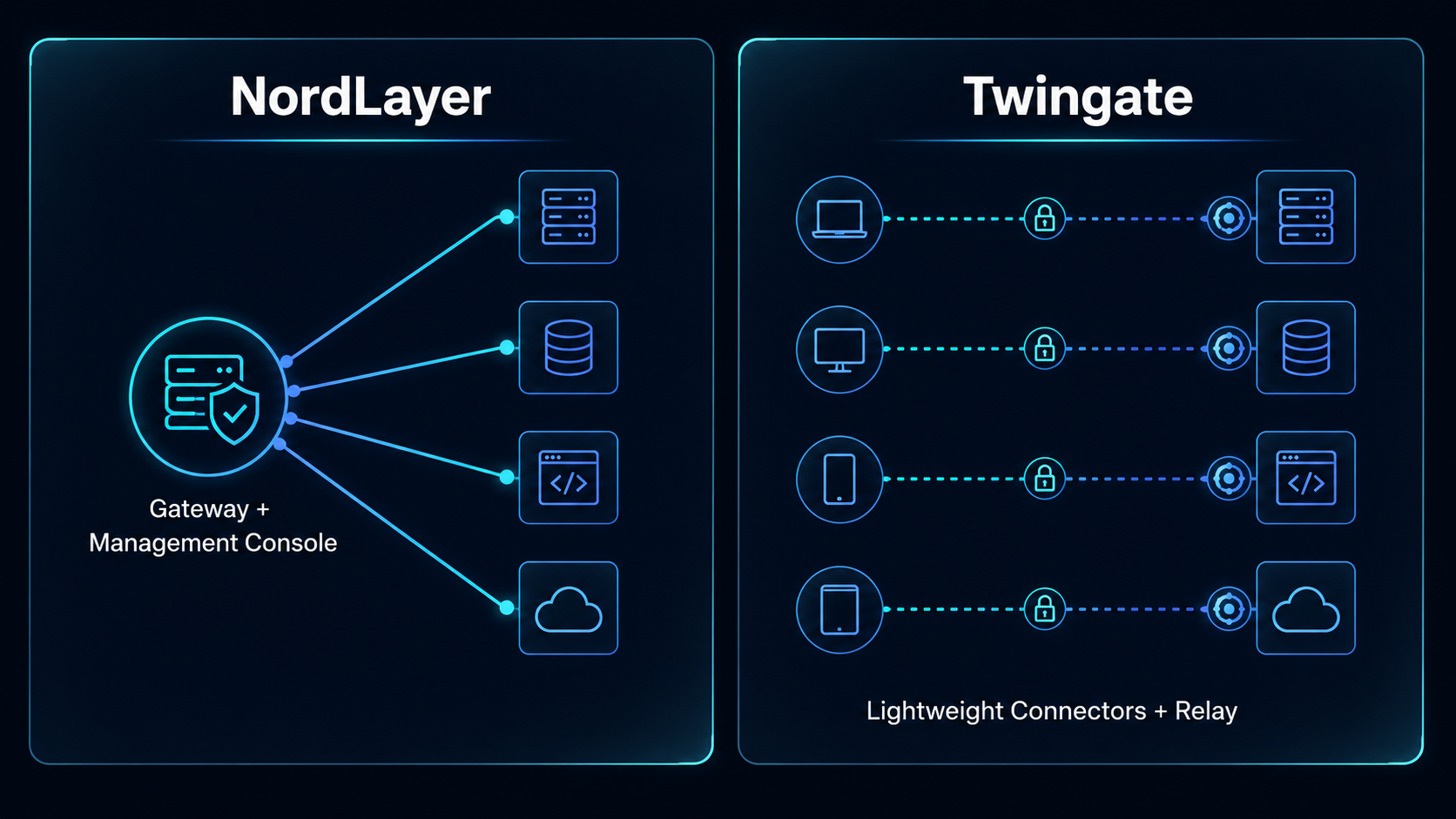
Twingate‘s own documentation describes an architecture built around lightweight connectors installed near your resources, whether that’s a cloud VPC, an office server, or an internal app, paired with a relay service that brokers encrypted, direct connections between the user and that resource. There’s no central gateway the company routes all traffic through. Twingate positions this as reducing latency and avoiding a single choke point, since traffic doesn’t have to detour through one company-operated hub.
This design tends to appeal to technically comfortable teams, engineering-heavy startups, or businesses that already have someone who understands networking concepts like split tunneling and DNS routing. Twingate’s free tier supports up to five users, according to pricing information from Vendr and SafetyDetectives, and that limit is a meaningful signal about who they see as their entry-level customer: a founder or small technical team testing Zero Trust before committing budget to it.
NordLayer’s Gateway Model
NordLayer, built by the team behind NordVPN, takes a more centralized approach. Its own documentation describes gateway servers paired with a management console designed to feel closer to a traditional network admin tool, rebuilt with Zero Trust principles like segmentation and per-app access. It bundles ZTNA-style access controls alongside more conventional network security features such as site-to-site connectivity, dedicated servers, and threat blocking.
Rather than chasing a specific headcount range, NordLayer’s pricing structure tells you who it’s built for. Plans start at a minimum of five users at $8 per user per month, according to TrustRadius pricing data, scaling up through an Enterprise tier meant for larger deployments. That structure fits businesses that have outgrown a consumer VPN but don’t have the staff to run something as complex as an enterprise SASE platform. The tradeoff for that centralized model is a setup many non-technical admins find more familiar, at the cost of some of the architectural flexibility Twingate emphasizes in its own marketing.
Setup and Day-to-Day Management
Neither company publishes a detailed, hour-by-hour implementation timeline for small businesses, so any claim about “deploy in 15 minutes” should be read as marketing language rather than an independently verified benchmark. What can be said more confidently is directional: Twingate’s connector-based model requires someone to understand where each resource lives on the network. NordLayer’s console-driven approach mirrors tools that a general IT generalist is more likely to have used before, even without a networking background.
For a business with no dedicated IT hire, that difference in day-to-day management can matter more than any feature comparison chart. If your “IT department” is the office manager who also handles payroll, a simpler admin console has real value even if it’s architecturally less flexible. If you have a developer or ops person on staff who’s comfortable with networking concepts, Twingate’s model may feel more natural and give more granular control.
Pricing and Who Each One Is Really For
Twingate’s free tier, capped at five users according to Vendr and SafetyDetectives, makes it easy for a very small team, or a single founder, to test the product before spending anything. Paid tiers scale up from there with more advanced admin controls and integrations. This structure fits businesses that want to prove out Zero Trust on a subset of employees before rolling it out company-wide.
NordLayer has no free tier. Its minimum plan runs five users at $8 per user per month, per TrustRadius pricing data, and a December 2024 TechRadar review of NordLayer confirmed the paid-only structure. That makes it a more natural fit for a company that already knows it wants one vendor covering VPN replacement, site-to-site connections, and ZTNA-style access controls together, rather than stitching together multiple point tools.
Neither company publishes independently verified customer counts or third-party case studies specific to small business deployments. Claims about being “trusted by thousands of businesses” on either vendor’s site should be read as marketing copy, not a sourced statistic.
Integration With Identity Providers
Both platforms support single sign-on integration with common identity providers like Okta and Azure AD, which matters because ZTNA is only as strong as the identity layer behind it. Verifying a device and a login once at connection time isn’t as useful if the underlying identity provider is weak or if multi-factor authentication isn’t enforced upstream.
Here’s what to check before you commit to a plan: both vendors vary which integrations are available at which pricing tier. A feature list on a marketing page may describe capabilities only available on a higher-tier plan, not the entry-level one a small business is likely to start on. Ask each vendor directly which specific integrations are included at the plan tier you’re actually evaluating, rather than assuming the general feature page applies to your quote.
What Independent Reviews Actually Tell You (And What They Don’t)
Both NordLayer and Twingate have active user bases on review platforms like G2 and TrustRadius, and reading through recent reviews there is a reasonable way to gauge current user sentiment before buying. Neither company has been the subject of a detailed independent lab evaluation from firms like Gartner or Forrester at a level of depth that would let a small business owner make an apples-to-apples technical comparison.
That gap matters. It means you’re relying more on user reviews, vendor documentation, and your own pilot testing than a neutral third-party benchmark. Running a pilot with a small subset of employees, rather than committing to a company-wide rollout on marketing claims alone, is a sensible way to de-risk the decision either way.
Which One Should a Small Business Actually Pick
If your team is under 10 people, has some technical comfort, and wants to try Zero Trust without spending anything upfront, Twingate‘s free tier is a low-risk starting point. Its per-resource connector model also tends to appeal to businesses whose “network” is really just a handful of cloud apps and a couple of internal servers rather than a traditional office setup.
If your business has a mix of office and remote staff and wants one vendor handling VPN replacement, gateway management, and access controls together, NordLayer‘s centralized, console-driven approach is likely to feel more manageable for a generalist IT hire or an office manager wearing multiple hats. It trades some of Twingate’s architectural flexibility for a setup style closer to what many small business admins already know.
Neither is objectively better in a vacuum. They’re built for different starting points: Twingate for lean, technical teams testing Zero Trust cheaply, and NordLayer for growing businesses that want a fuller network security package under one roof.
Back to the Bakery, the Law Firm, and the Agency
The bakery with four locations and shared inventory software probably wants the simpler, more centralized console NordLayer offers, since its needs look more like traditional network security with a Zero Trust upgrade. The twelve-person law firm, cautious about client data and light on technical staff, might value that same simplicity, or might prefer Twingate’s more granular per-app controls if a paralegal on staff is comfortable managing it. The agency that just lost its office and went fully remote overnight is arguably the best fit for Twingate’s free tier: no infrastructure to reconfigure, just a handful of remote workers who each need access to a few specific tools.
None of these businesses need to guess. A short pilot with real employees, on real work, against the actual pricing tier they’d pay for, will tell them more in two weeks than any comparison article, including this one, ever could.